Gamehub : Data Intelligence Platform for iGaming Operations
2025
Client
The Multiple

Project overview
My Role: Product Designer (UX/UI)
Project Scope: Product strategy, UX architecture, data visualisation, UI design
Usage Platform: Web-based backend system
Industry: iGaming
Executive Summary
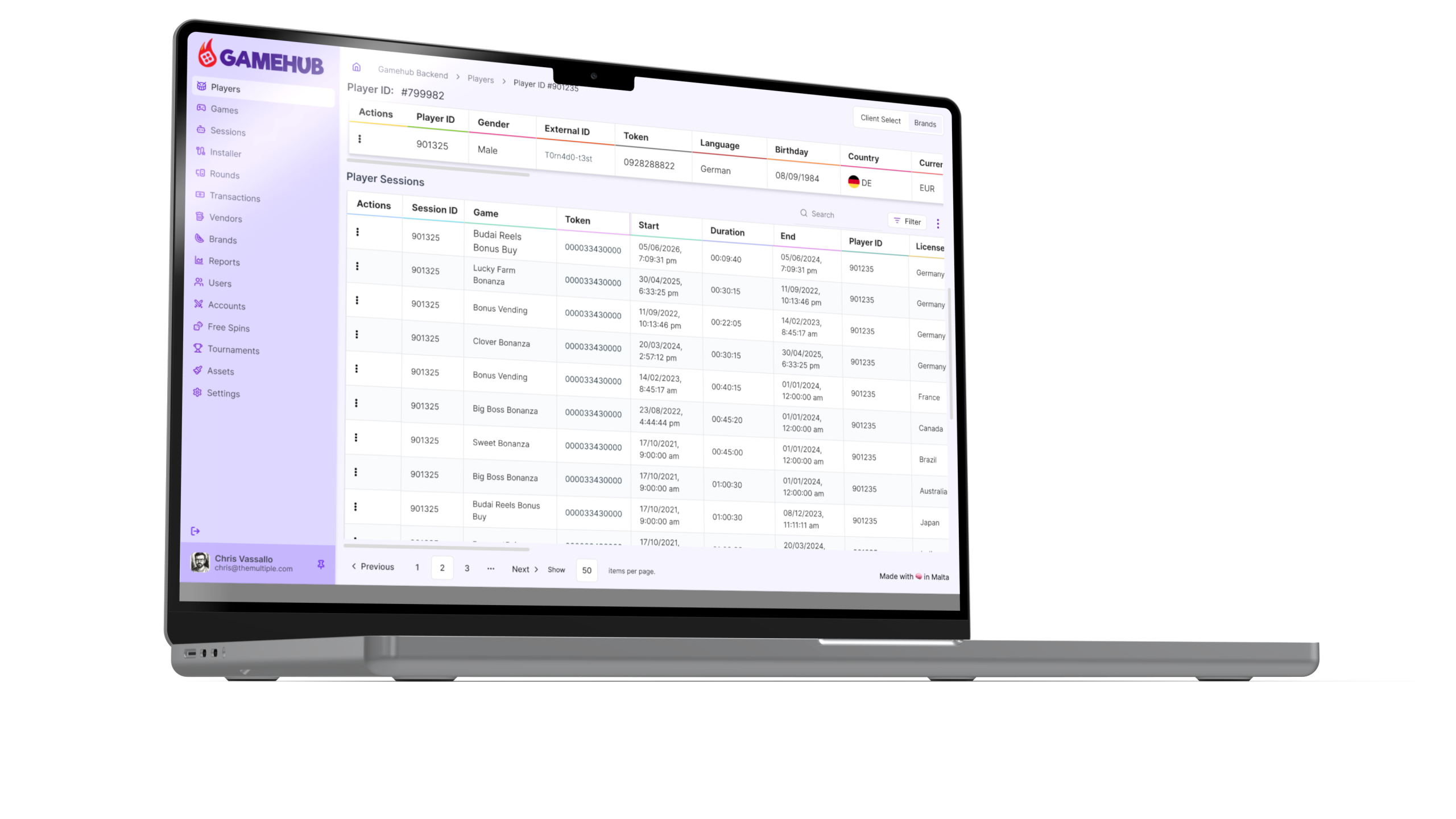
Gamehub is a centralised backend analytics platform built for a multi-brand iGaming operator.
The product consolidates high-volume gaming data — sessions, spend, transactions, and player behaviour — into a single performance command centre used by operations, marketing, and executive teams.
The objective:
Turn fragmented data into real-time, decision-ready intelligence.
Business Problem
Before Gamehub:
-
Reporting was manual and time-intensive
-
Data lived across disconnected systems
-
Brand-level performance lacked clarity
-
Player spend and session trends were difficult to track in real time
-
Operational teams relied on exported spreadsheets
Decision-making cycles were slow.
Performance insights were reactive instead of proactive.
The business needed:
-
Real-time performance visibility
-
Cross-brand analytics
-
Granular player-level insights
-
Faster operational control
-
Scalable reporting infrastructure

My Role and Input
I led the UX and UI design of the platform, including:
-
Defining the information architecture
-
Structuring dashboard hierarchy
-
Designing high-density data tables
-
Creating scalable filtering systems
-
Building interaction patterns for management workflows
The goal was to balance complexity with usability.
Strategy & Approach
1. Architect Around Decisions — Not Data
Instead of designing around raw metrics, I structured the platform around key operational questions:
-
Which games are driving revenue today?
-
Which brands are underperforming?
-
Who are the high-value players?
-
Where are behavioural drop-offs happening?
This reframed the dashboard into a decision-support system.
2. Build a High-Density, High-Clarity UI
iGaming back-office tools demand data density.
The challenge wasn’t reducing information — it was structuring it.
Key principles applied:
-
Clear KPI grouping
-
Strong typographic hierarchy
-
Predictable filtering logic
-
Side-panel editing to preserve context
-
Toggle-based brand state management

Key Features & Measurable Impact
1. Real-Time Performance Dashboard
Displays:
-
Revenue trends
-
Session volumes
-
Total spend
-
Transaction activity
-
Comparative time analysis
Impact:
-
Reduced time to access daily performance insights by ~60%
-
Eliminated dependency on manual spreadsheet reporting
-
Enabled same-day performance optimisation decisions
2. Game Management System
Structured data tables allow administrators to:
-
View and manage all games by ID and category
-
Toggle brand associations
-
Activate/deactivate titles
-
Edit configurations within a side-panel
Impact:
-
Reduced configuration time per game update
-
Improved operational efficiency for brand launches
-
Decreased context-switching during editing workflows
The side-panel interaction prevented page reload cycles, increasing task completion speed.
3. Brand-Level Visibility
Games can be assigned to multiple brands with clear visual identifiers and state toggles.
Outcome:
-
Improved accuracy in brand availability management
-
Reduced misconfiguration risk
-
Increased confidence in cross-brand reporting
4. Advanced Filtering & Segmentation
Users can segment by:
-
Date range
-
Brand
-
Game category
-
Player spend thresholds
-
Activity levels
Results:
-
Enabled granular campaign targeting
-
Improved ability to identify high-value player cohorts
-
Shortened insight discovery time significantly
Operational teams moved from static reports to dynamic data exploration.
5. In-Depth Reporting Infrastructure
The reporting dashboard supports:
-
Revenue breakdowns
-
Behaviour analysis
-
Transaction summaries
-
Export-ready datasets
Improvements:
-
Reduced reporting preparation time for stakeholders
-
Enabled executive-level snapshot reporting
-
Centralised performance intelligence into a single system
Gamehub became the organisation’s reference point and source of truth.
Design Challenges Solved
Managing Data Complexity
Large datasets without overwhelming users.
Balancing Density with Clarity
High information load while maintaining scannability.
Reducing Cognitive Friction
Predictable filtering logic and consistent interaction patterns across modules.